
E-commerce
Cross-border E-commerce Throughput
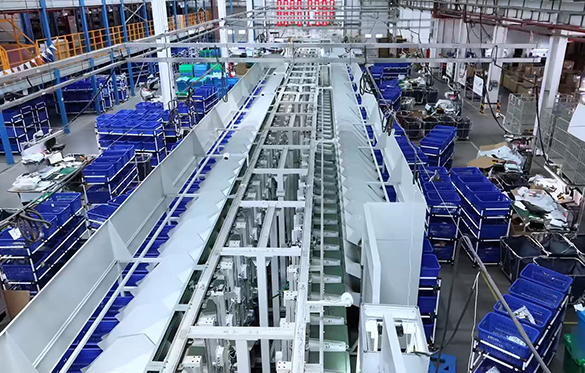
Six auto induction stations and dual-cart sorting reduced staffing from 30 to 6 and raised systematic throughput above 9,000 pcs/h.
Project Background
A well-known cross-border e-commerce company processes 80,000 to 100,000 outbound pieces per day across a multi-level warehouse.
Main Pain Points
Before automation, the project faced these operational pressures.
- Manual first sorting and second sorting made the process long and inefficient
- Hundreds of order waves required repeated handling and high labor input
- 80,000-100,000 outbound pieces per day required stronger process design and throughput
Solution Configuration
Tegene configured the solution around site flow, parcel profile and throughput goals.
- Configured 3D Sorter for high-throughput mechanical sorting capability
- Used six automatic induction stations to improve front-end feeding rhythm
- Applied a dual-cart sorting structure for one-pass order sorting and smoother flow
Project Result
Six auto induction stations and dual-cart sorting reduced staffing from 30 to 6 and raised systematic throughput above 9,000 pcs/h.
- Replaced traditional first-sort and second-sort manual work, reducing staffing from 30 people to 6 and saving 24 skilled workers
- Improved sorting efficiency from about 300 pcs/h manually to more than 9,000 pcs/h systematically
- Clear payback with ROI within 2 years
- Stably supports 100k-level daily order processing
Project Results
For 80,000-100,000 outbound pieces per day, six automatic induction stations and dual-cart sorting reduced staffing from 30 to 6 and raised throughput above 9,000 pcs/h.
Who This Fits
Useful for similar industry customers, system integrators and warehouse operators evaluating sortation automation.
- Cross-border e-commerce warehouses with high daily volume and peak waves
- Multi-level warehouses, overseas warehouses and 3PL high-throughput sortation projects
- Customers needing automatic induction and 10k+ throughput capacity
Getting Started on a Similar Project
If this project looks like yours, having site space, volume, parcel profile and system interface details ready makes it much faster to size the equipment.
- Warehouse area, available equipment zone, height, aisles and checking or packing area
- Average volume, peak volume, order waves, main destinations and growth expectation
- Parcel size, weight range, barcode/RFID recognition and induction mode
- WMS/MES, conveyors, custom automation and local integrator cooperation boundaries
Next Step
Turn this scenario into a deployable plan
Tell us your site size, parcel mix, peak volume and target market — we’ll respond with a specific configuration and deployment plan.
Contact Us